Collaboration between Zlín and Spanish Chemists Pushes the Boundaries of Photochemical Switching
28. January 2026Chemists from the Faculty of Technology at Tomas Bata University in Zlín, in collaboration with colleagues from the University of Huelva in Spain, have achieved a major breakthrough in the field of supramolecular photochemistry. The results of this international collaboration have been published in the prestigious Journal of the American Chemical Society (JACS), a globally recognised forum for cutting-edge research in chemistry and related scientific disciplines.
The research focussed on a family of molecular photoswitches known as donor–acceptor Stenhouse adducts (DASA), whose photochromic properties were first described in 2014. These compounds hold promise for a wide range of applications, from photosensitive materials and targeted drug delivery to sensors and photopharmacology. Until now, however, their practical use has been severely limited by the fact that their photochromic behaviour could only be controlled in organic solvents, not in water – the key medium for biological and medical applications.
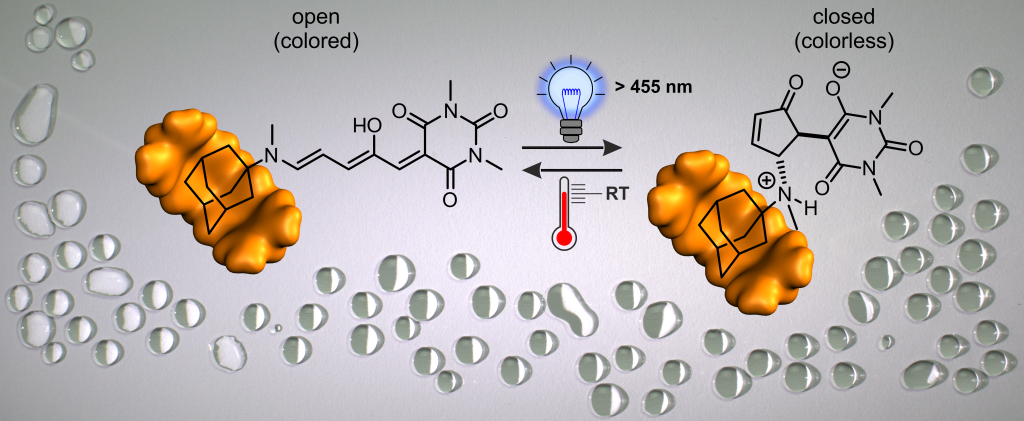
Supramolecular chemists from Zlín and photochemists from Huelva have now succeeded in overcoming this limitation. How? “We revisited first-generation DASA and modified their structures to enable the formation of stable supramolecular host–guest complexes with macrocyclic compounds from the cucurbituril family,” explains the head of the Zlín research group, Dr Robert Vícha. In water, DASA derivatives usually undergo spontaneous and irreversible ‘deactivation’, changing their structure into a closed, colourless form. The researchers, however, discovered a way to stabilise these molecules in an aqueous environment while preserving their ability to respond repeatedly to light and to reversibly change their geometric arrangement.
“The donor part of the prepared DASA derivatives was modified by introducing an adamantyl motif, which selectively binds to a macrocyclic host molecule – in this case, a cucurbituril. This interaction proved to be crucial for reversible photoswitching of the system in an aqueous environment between two forms – open (coloured) and closed (colourless) – using light, much like a switch,” adds Dr Michal Rouchal, co-author of the study.
The significance of this discovery is further underlined by the fact that reversible, light-controlled switching of first-generation DASA derivatives in water had long been considered practically unattainable. Moreover, the newly proposed strategy is general in nature and may also be applied to other types of molecular systems.
The published work is the result of close international collaboration between chemists from Zlín and a research team from the University of Huelva led by Professor Uwe Pischel. The results confirm that advanced fundamental research in organic and supramolecular chemistry carried out in Zlín has a strong international impact and the potential to bring about transformative innovations across a range of fields.